
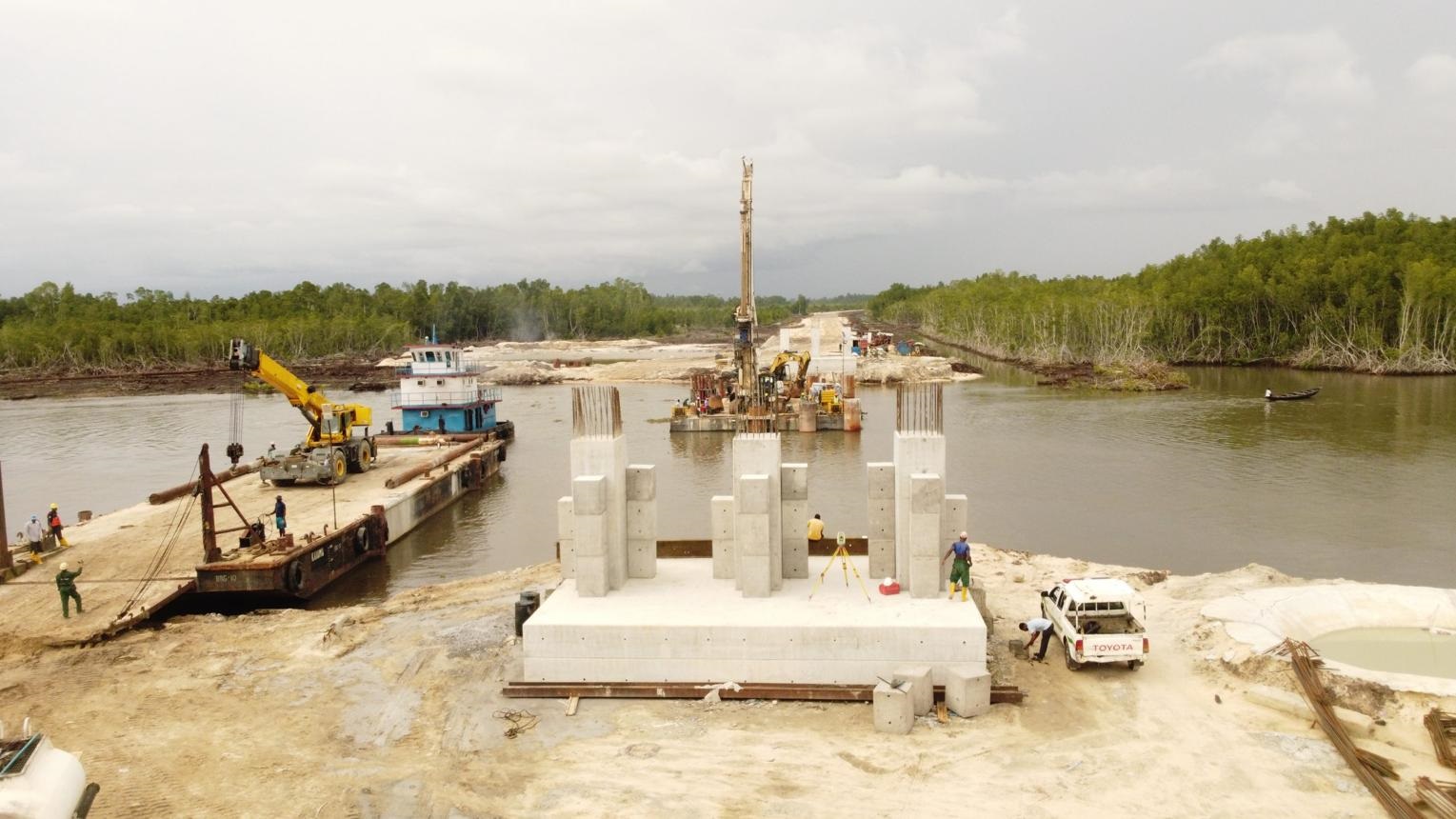
With 85 per cent of the 21-kilometre first phase reportedly completed and commissioning targeted for March–April 2027, expectations are rising that the Nembe–Brass Road could reshape transportation, commerce and economic opportunities in Bayelsa East. But residents say the real test will be whether the project delivers lasting benefits to communities beyond the construction corridor.
For generations, communities across the Nembe–Brass axis of Bayelsa State have endured the difficulties of transportation in a landscape dominated by creeks, rivers, mangrove forests and scattered settlements. For residents, traders, fishermen and other economic operators, movement between communities has often depended on waterways, making the transportation of goods and access to essential services difficult and expensive.
Today, however, a long-awaited infrastructure project is raising fresh hopes of change.
The 21-kilometre first phase of the Nembe–Brass Road project is approaching completion, with the Bayelsa State Government projecting that the road will be ready for commissioning between March and April 2027.
During an inspection of the project on October 23, 2026, the Commissioner for Works and Infrastructure, ESV Moses Teibowei, said approximately 85 per cent of the work had been completed, leaving about 15 per cent outstanding.
The inspection brought renewed attention to a project regarded as one of the major infrastructure interventions aimed at improving connectivity in Bayelsa East Senatorial District.
For the people of Nembe and Brass, the road represents more than an engineering achievement. It offers the prospect of a new economic corridor capable of linking communities, improving mobility and creating opportunities in an area whose development has long been constrained by difficult terrain.
The final stretch towards completion
According to Teibowei, construction activities are progressing towards the completion of the first phase, with attention focused on the fifth and final bridge along the road corridor.
He explained that preparations were underway for the launching of the bridge beams, with equipment already at the site and being assembled for the operation.
The commissioner maintained that construction was being carried out in accordance with approved engineering designs and quality standards. He also stated that materials used for the project were subjected to testing at the ministry’s quality-control laboratory.
The contractor, Setraco Nigeria Limited, also expressed confidence in meeting the projected delivery period.
The company’s area manager for Bayelsa State, Engr. Joajoa Cosme, confirmed that sand-cement stabilisation and the first layer of stone base had been completed up to kilometre 21, while the final box culvert had also been completed.
The latest update follows an earlier inspection in September by the Chairman of the Directorate for Project Monitoring and Evaluation, Hon. Engr. Ebiye Tarabina, who assessed the progress of construction on the road and bridges.
The inspection highlighted the advancement of bridge structures and pavement preparation along the 21-kilometre stretch. <Cite refs={[“turn466652search0″,”turn466652search3”]}/>
Although the projected commissioning date has generated optimism, the remaining construction works must be completed to the required standard before the road can deliver its full benefits to users.
A project with far-reaching economic implications
The potential economic importance of the Nembe–Brass Road lies in its capacity to improve the movement of people, agricultural produce, fish, building materials and other commodities.
In communities where transportation difficulties can increase the cost of doing business, improved road access could reduce some logistical burdens and make local markets more accessible.
For fishermen and fish traders, better connections to markets could improve the movement of fresh and processed seafood. Farmers could also benefit from easier transportation of produce, while traders and small-business owners may find it easier to expand their operations.
The road could also encourage investment in accommodation, hospitality, retail services, transport operations and other businesses that depend on reliable access.
However, these benefits will not emerge automatically from the construction of a road. They will depend on the quality of the completed infrastructure, the accessibility of adjoining communities, security, electricity, communications and the willingness of investors to establish viable businesses in the area.
The project therefore presents an opportunity for the Bayelsa State Government to develop a broader economic plan that connects infrastructure delivery with employment generation and local enterprise development.
Such a plan could include skills acquisition for young people, support for small businesses, organised fish markets, agricultural processing facilities and improved storage and transportation systems.
Without these complementary investments, the road may improve movement without fully transforming the economic circumstances of the people it is intended to serve.
Opening the door to the marine economy
Brass occupies a strategic position along Nigeria’s Atlantic coastline, giving the wider Nembe–Brass area potential for marine-related economic activities.
Improved road access could strengthen the connection between inland communities and coastal economic centres, supporting opportunities in fishing, seafood processing, logistics, marine services and tourism.
In a September 2026 report by Vanguard, the Amadabo of Moko-Ama in the Sangana/Akassa area of Brass Local Government Area, HRH King Theophilus Moses, described the road as a potential economic game changer.
He argued that improved accessibility could attract businesses, create employment and support the development of the marine economy. <Cite refs={[“turn466652search5”]}/>
For these ambitions to become reality, the state government and relevant federal agencies would need to consider supporting infrastructure, including suitable landing facilities, storage systems, reliable power supply and investment in local skills.
The road could also improve access for public services and strengthen the movement of emergency responders, subject to the final route’s connections and the condition of the completed infrastructure.
These possibilities make the project significant beyond its immediate construction objectives. It could become part of a wider strategy for connecting Bayelsa’s riverine economy to regional and national markets.
Communities must not be left behind
Despite the optimism, questions remain about how widely the benefits will spread.
One important concern is whether communities located away from the main road corridor will enjoy meaningful improvements in accessibility.
In the same Vanguard report, Ayibatonye Koki, an indigene of Sangana, expressed concern that some communities could remain poorly connected despite the progress being made on the road.
He raised questions about transportation difficulties that could persist for residents who still depend on waterways to reach major settlements. <Cite refs={[“turn466652search5”]}/>
The concern highlights an important development issue: a major road can transform the communities it directly connects while leaving nearby settlements struggling with the same challenges if feeder roads, landing facilities and connecting routes are not provided.
The state government must therefore consider the needs of smaller communities when planning subsequent phases and complementary infrastructure.
Community engagement will also be important in identifying the most pressing local needs, preventing avoidable disputes and ensuring that development priorities reflect the experiences of residents.
The objective should be to create a transport network that benefits the wider Nembe–Brass area rather than concentrating economic opportunities around a limited section of the route.
Funding, quality and accountability
The completion of the first phase will depend on sustained construction activity, adequate funding, effective supervision and compliance with engineering standards.
Teibowei has said the project is progressing according to approved designs, while the contractor has indicated that it has no funding difficulties with the state government.
These assurances are encouraging, but the public interest extends beyond the announcement of a completion date.
Residents deserve clear information about the remaining works, the quality-control process, the durability of the bridges, drainage provisions and the maintenance arrangements that will protect the investment after commissioning.
The government should also communicate clearly about the distinction between the 21-kilometre first phase and the wider Nembe–Brass corridor. Completion of the present phase should not be interpreted as completion of every road connection required to serve the entire area.
Transparent reporting on expenditure, milestones and construction standards would help sustain public confidence and allow citizens to assess the project on the basis of verifiable progress.
Beyond commissioning: The real test
The Nembe–Brass Road has reached a stage where public attention is shifting from construction progress to the benefits that residents can reasonably expect when the first phase is completed.
For Governor Douye Diri’s administration, meeting the projected March–April 2027 commissioning window would mark an important milestone. But the lasting value of the project will be measured by what happens afterwards.
Will transportation become more affordable? Will traders gain better access to markets? Will young people find employment? Will businesses invest in the area? Will communities outside the immediate corridor receive improved connections?
These are the questions that should guide the next stage of planning.
A completed road can provide the foundation for economic development, but sustained investment, effective maintenance, security and inclusive planning are necessary to turn that foundation into lasting prosperity.
For the people of Bayelsa East, the Nembe–Brass Road carries the promise of easier movement and a more connected future. The challenge before the government, contractor and community stakeholders is to ensure that the promise becomes a practical reality.
As work continues on the final bridge and other outstanding sections, expectations will remain high. If the project is completed to the required standard and supported by complementary investments, it could become an important catalyst for economic activity across the Nembe–Brass axis.
For now, the countdown to the projected commissioning has begun. The ultimate verdict, however, will come not from the ceremony that opens the road, but from the improvements it brings to the daily lives and economic prospects of the people of Bayelsa East.